

A Lesson from the Zen Master of Monkey Forest
The Sacred Monkey Forest in Übud, Bali is a whirlwind of activity. The moment you step inside, you’re enveloped in a world of chattering, screeching and constant motion juxtaposed against lush jungle, trickling fountains and quiet birdsong. But this is far more than just a nature reserve; it is a sacred space with a history stretching back to the 14th century, home to ancient Hindu temples that peek through the dense jungle canopy.
The entire sanctuary is built on the Balinese philosophy of Tri Hita Karana, the “three causes of well-being”—harmony with the divine, harmony with people, and harmony with nature. The forest itself is considered a living embodiment of this principle, where roughly 1,200+ macaque monkeys are not just seen as its wild inhabitants, but rather sacred guardians and extensions of the forest’s spirit. In Balinese belief, this sanctuary represents the essential balance between chaos and harmony—a balance I witnessed unfolding all around me.
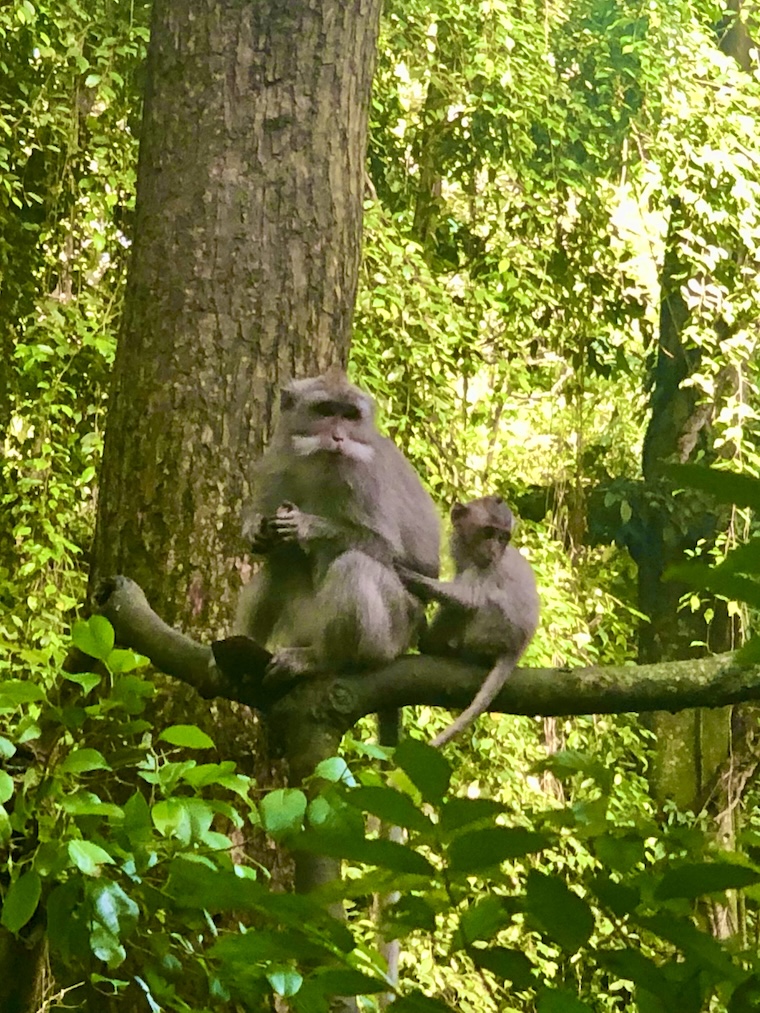
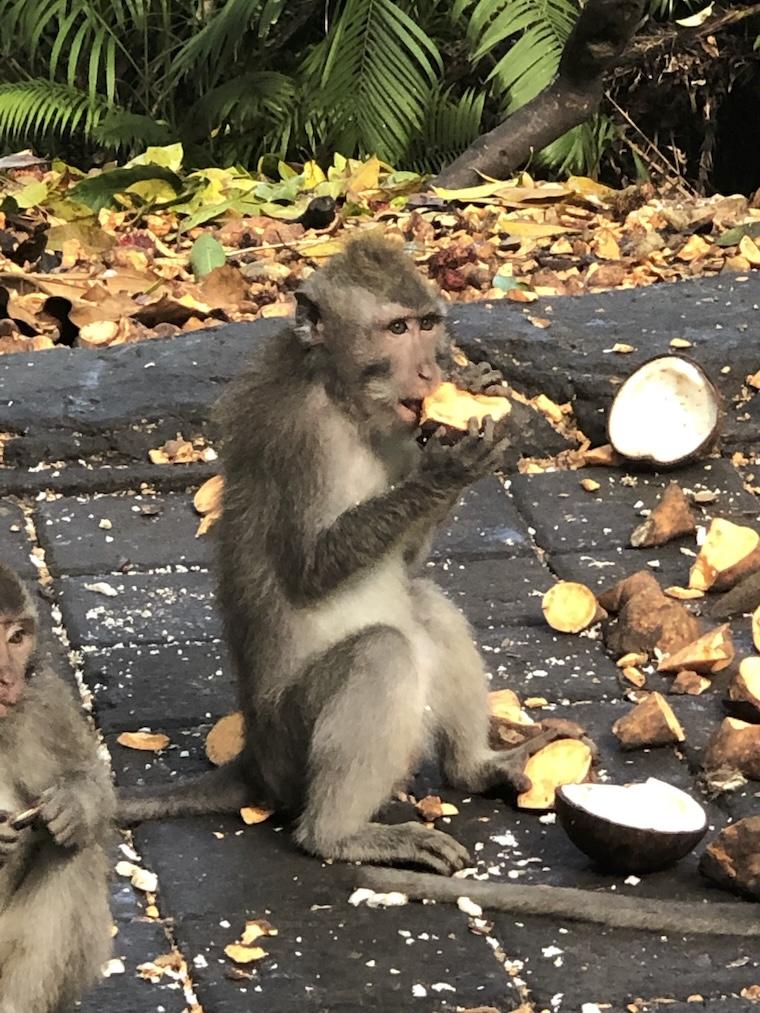
Long-tailed macaques are everywhere. They chase each other up and down ancient temple walls, squabble over bananas and coconuts, groom one another with intense focus and swing about dramatically from overhead vines. The air is thick with their energy—a chaotic, restless and endlessly busy society.
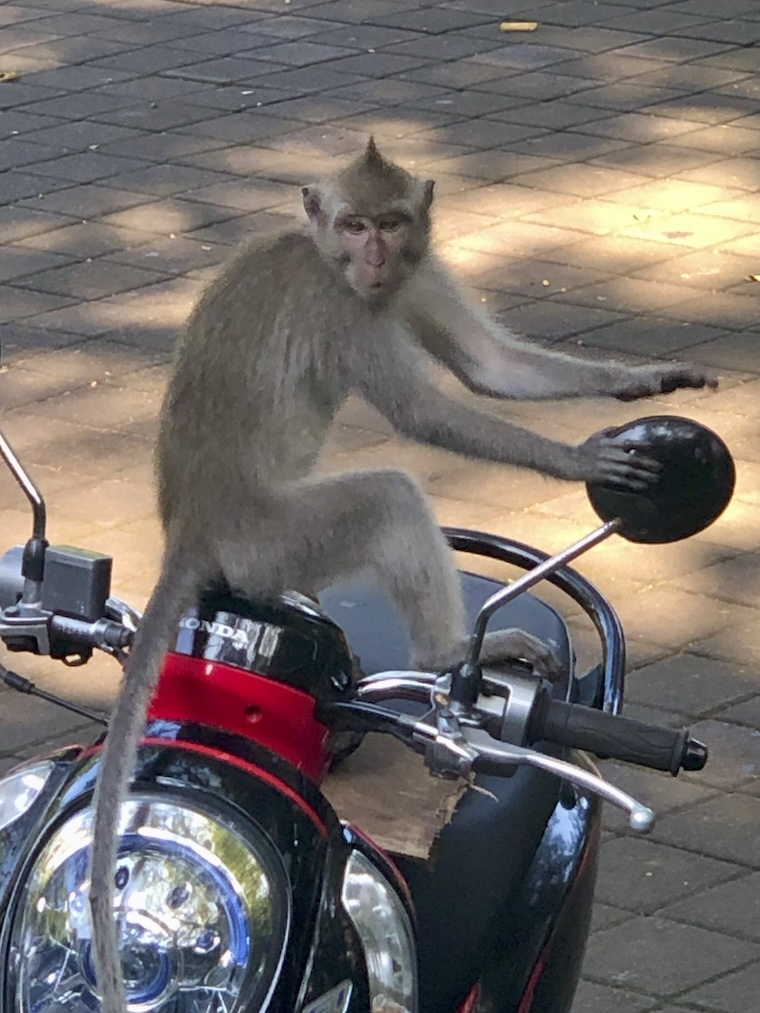
It is a perfect, living metaphor for what Buddhists call the “monkey mind”—that untamed part of our consciousness that leaps from thought to thought, swings from worry to distraction, and rarely, if ever, sits still. Walking through the forest that day, I was completely captivated by the external display of what so often happens inside my own head.
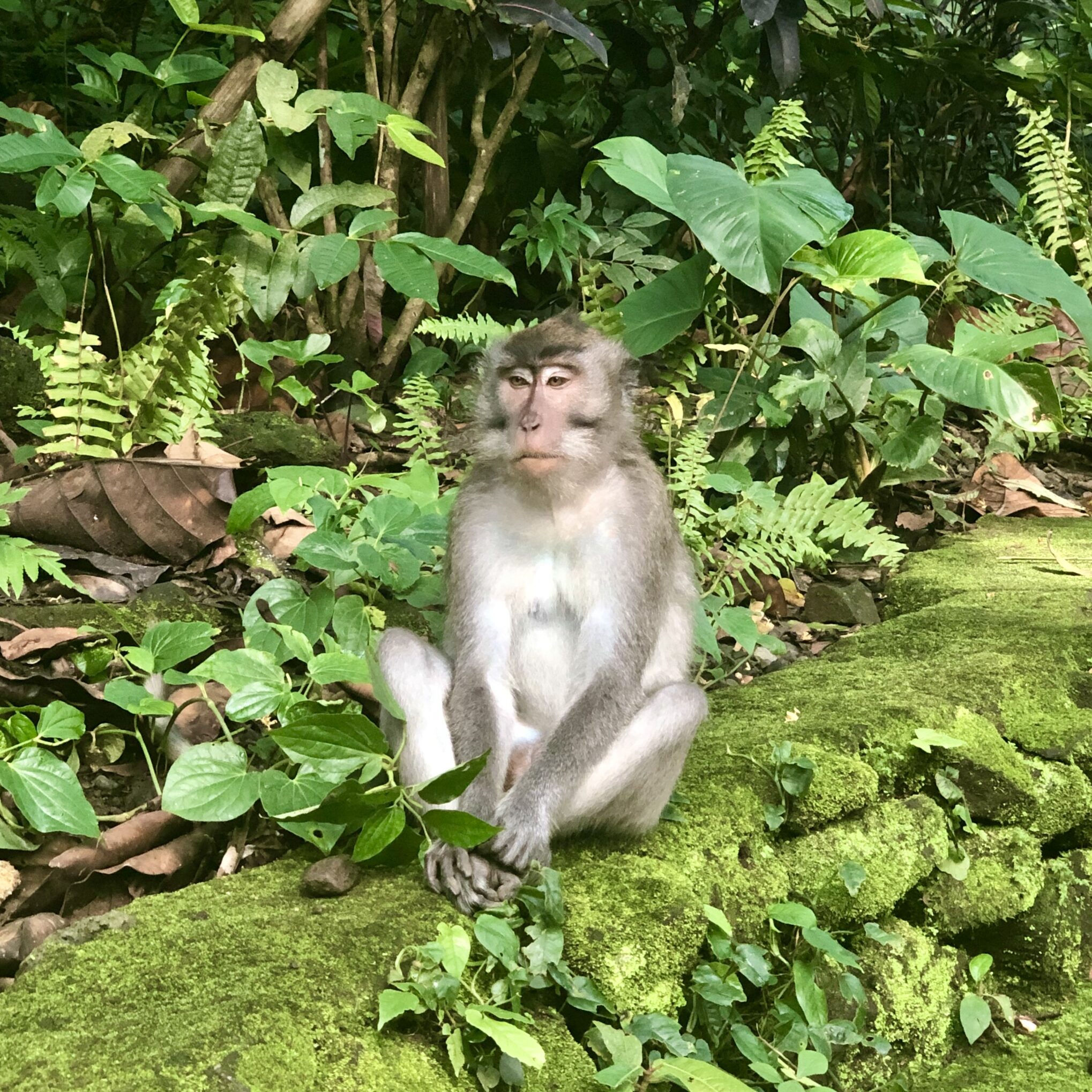
My gaze followed the flurry of activity, from a tangle of juveniles play-wrestling to a mother diligently grooming her infant. It was a dizzying, delightful spectacle. Yet, as I scanned the scene, my eyes were drawn to a quiet space away from the main group—a single monkey sat on a moss-covered stone wall in stark, silent contrast to the chaos around it.
There was an aura of profound stillness about him. While his peers were a blur of motion, he was unmoving, his hands resting gently in his lap. His eyes were open but soft, fixed on nothing in particular, as if in a meditative, trance-like state. He was the epitome of Zen—calm, present and completely at peace.
I stood there and watched him for a long time, expecting him to get up at any moment and rejoin the frenzy. But he didn’t. He just stayed there, breathing and being. He was in the middle of the chaos, but he was not of the chaos.
In that moment, I realized the most profound lesson the forest had to offer. We often believe that to find peace, we need to escape our daily lives. We tell ourselves, “I’ll be calm once this project is over,” or “I’ll relax when I’m on vacation,” or “I need to get away from it all to find quiet.” We think we need to leave the noisy “forest” to get some peace of mind.
But this “Zen master” taught me something completely different. He wasn’t in a silent cave on a remote mountaintop; he was in the heart of the liveliest, most chaotic place imaginable. Yet, he demonstrated that peace isn’t always about changing our external circumstances. Peace is about cultivating a quiet centre within ourselves. Peace is an internal state of being, accessible at any time, no matter what is swinging and screeching around us.
The goal isn’t to silence the world—an impossible task. The goal is to find the stillness within it. That monkey, surrounded by the literal embodiment of the “monkey mind,” was a powerful reminder that our own inner peace is always available to us. We just have to remember to pause, take a deep breath, and let the chaos of the world unfold without losing our connection to our own calm centre.
What would be possible for you if you were able to stay connected to your calm centre, no matter the chaos around you?
Sign Up for Insights Inspired by Nature & Other Curious Places
Receive light-hearted coaching reflections and practical wisdom—never more than once a month.